A timber beam salvaged from an old building can find a second use if it is removed intact and a buyer needs timber of that size and quality. At Ecomondo 2026, the international circular economy exhibition held in Rimini on Italy’s Adriatic coast from 3 to 6 November, much of the discussion turned on a similar question. Under what conditions can manufacturers use what others discard to replace some of the raw materials they buy?
The fair’s programme included 200 events, 70 of them curated by its international scientific and technical committee. Across sessions on textiles, plastics, packaging, paper and water, one concern for manufacturers was the reliability of supply. A factory considering treated wastewater needs to know whether it can count on that supply during a dry spell. For a textile mill buying recovered fibre, the question is whether the next batch will meet the same specifications as the last.
What it takes to keep textiles in circulation
On the opening day of Ecomondo, the Tuscan textile district of Prato brought a question to Rimini that matters to manufacturing regions across Europe. How can a district cut emissions while keeping its mills competitive and its workforce in place? The Prato Net Zero Textile District session explored what decarbonisation could look like in 2030, 2040 and 2050. Elsewhere on the programme, a session on textile “end-of-waste” rules examined a question closer to the factory floor. At what point can recovered material cease to be classified as waste and be sold to a manufacturer as a raw material?
For much of Italy’s discarded clothing, the first hurdle is getting it into a separate collection at all. In 2023, Italian municipalities collected 171,600 tonnes of textiles separately, up about 7% on the previous year. The service reached 81% of municipalities, yet more than a million tonnes of textiles still went into mixed municipal waste. Sorting and processing capacity also limited what could be recovered. Even among textiles that were recycled, a substantial share went into products outside the textile industry. On the supply side, Italy placed about 1.4 million tonnes of textile products on the market in 2024, almost two-thirds of them clothing.
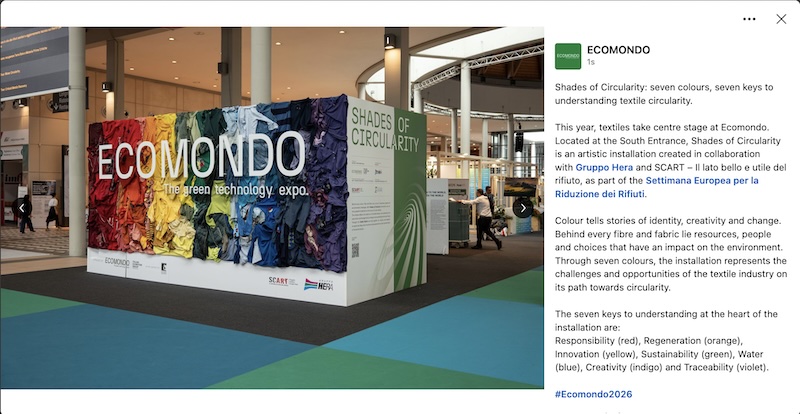
The pattern extends across Europe. According to the 2025 report Il riciclo in Italia, cited by Ecomondo, the EU generated 6.94 million tonnes of textile waste in 2022, or 16 kg per person. Around 85% of household textile waste went into the general bin. That helps explain the attention given at Rimini to extended producer responsibility for textiles and footwear. Under the EU framework, producers will help fund and organise collection, sorting, preparation for reuse and recycling. In Italy, that means working with municipalities, social enterprises and specialist sorting firms that already handle used clothing.
Some textiles become waste before anyone has worn them. Ecomondo cited estimates that between 4% and 9% of textile products placed on the European market are destroyed before use, equivalent to 264,000–594,000 tonnes a year. Since 19 July 2026, the EU’s Ecodesign for Sustainable Products Regulation has prohibited large companies from destroying unsold clothing, clothing accessories and footwear, subject to limited exceptions. For retailers, that shifts part of the work of preventing textile waste back to the point where unsold stock is still in their hands.
What manufacturers need from recycled materials
A textile mill buying recovered fibre needs to know its composition and whether the supplier can deliver consistent quality. Manufacturers face much the same questions when they buy recycled plastics, paper or metals. Battery recycling offered one example at Rimini, where the EU-funded RENOVATE project explored how to recover materials from batteries with different chemistries.
Digital tools, including artificial intelligence, have a role in these decisions. In a sorting plant, the practical question is whether a system can identify materials accurately enough to improve the quality of what leaves the facility. In a factory, monitoring water and energy use can show operators where a change to one process would have the greatest effect. Both applications give businesses a way to judge an investment against something they can measure.
Where water reuse meets climate adaptation
Reusing treated wastewater brings the industrial and environmental arguments together particularly clearly. For a factory, reclaimed water can reduce demand for freshwater. For the surrounding community, the same investment can ease competition for local supplies during dry periods. The details are local: the quality of water a particular process requires, the distance from a treatment plant and whether the supply will be reliable when demand is highest.
That is a pressing issue for southern Italy and other parts of the Mediterranean, where decisions about water link farms, factories and cities drawing on the same catchment. Ecomondo’s programme placed water management alongside soil remediation, ecosystem restoration and climate adaptation. Seen from the coast, the relationship is especially clear. What happens upstream affects the quality of the water reaching the sea, with consequences for fisheries, aquaculture and coastal communities.
The same reasoning applies to the regenerative bioeconomy, another focus of the fair. Agricultural and forestry residues can supply materials, chemicals or energy. Yet some of what a business might classify as a residue also has a function where it falls, returning nutrients and organic matter to the soil. Deciding how much to recover, and what to leave in place, is part of making those supply chains viable over time.
A Mediterranean discussion with a wider reach
Resource security also gave the international programme a sharper focus. The sixth Africa Green Growth Forum addressed cooperation across the Mediterranean and Africa. Alongside it, Ecomondo introduced an Africa Investment Hub to connect businesses with African industry associations. Mexico became the fair’s first guest country, while a delegation of 11 Brazilian agrifood start-ups brought another perspective on how biological resources are used in production.
According to organiser Italian Exhibition Group, international attendance rose by 14% compared with the previous edition. More than 1,800 brands exhibited, 21% of them from outside Italy. Those figures give a sense of the audience for the technologies discussed in Rimini. Their industrial impact will be easier to judge in tonnes of virgin material displaced, cubic metres of freshwater saved and the ability of a plant to keep operating when supplies tighten.
Ecomondo will return to Rimini from 9 to 12 November 2027 for its 30th anniversary.