What remains of the Olympics when the spotlight goes off? It’s a question that surfaces often after major sporting events — but beyond records and infrastructure, the most precious legacy is a cultural one. The 2026 Milan Cortina Winter Olympic and Paralympic Games are approaching with an ambitious promise: to be not just an extraordinary sporting showcase, but a driver of greater social justice.
The theme was at the heart of the event “Olympics and Equality: New Perspectives,” held at Palazzo Visconti in Milan. There, Fondazione Bracco, in collaboration with Fondazione Milano Cortina 2026, the International Olympic Committee (IOC) and the City of Verona, reaffirmed that sport is by nature a powerful vehicle for inclusion — but that the road to true gender equality is still dotted with obstacles, many of them barely visible.
Fondazione Bracco is participating in the Cultural Olympiad of Fondazione Milano Cortina 2026 with a scientific research project and a new chapter of its photography exhibition, featuring portraits by Gerald Bruneau, dedicated to women and sport. “We are committed to making women’s expertise visible,” said Diana Bracco, President of Fondazione Bracco, underlining how these life stories can be a powerful source of inspiration. A point echoed by Verona city councillor Alessia Rotta, who stressed that investing in women’s sport means investing in social justice and in the future.
A Visibility That Risks Fading After the Games
To change reality, you must first measure it. The research promoted by Fondazione Bracco and the IOC was presented by Monia Azzalini, Head of Diversity, Equity and Inclusion at the Osservatorio di Pavia. The findings reveal some telling contradictions: while media coverage during the Paris 2024 Games was perfectly balanced (51% of stories dedicated to women), in the months that followed, coverage of female athletes collapsed to just 25%.
Football continues to dominate the news cycle (40% of all coverage), while remaining an almost exclusively male domain (98%). Skiing, by contrast, stands out as an island of equity, with coverage that genuinely rewards female talent. But the starkest figure concerns the Paralympics: the media gap remains deep — 54 news items versus 476 for the Olympics — a sign that much work remains to be done in recognising Paralympic sport as athletic excellence beyond physical barriers.
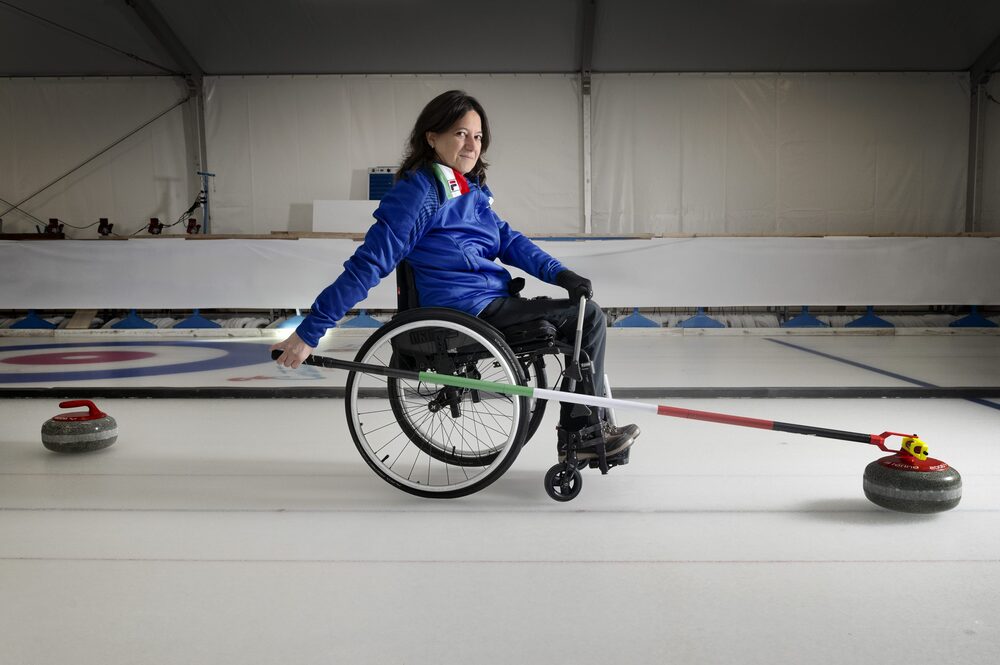
Knowledge and storytelling are therefore crucial: if a girl never sees female champions on TV or in the papers, she is unlikely to dream of becoming one herself. This is why the photography exhibition Una vita per lo sport. Volti e conquiste delle #100esperte (A Life for Sport. Faces and Achievements of the #100experts) carries deep social and political significance. Gerald Bruneau’s portraits will be on display in Verona, in an open-air exhibition along Corso Porta Borsari, from 4 February to 15 March 2026. It is an updated version of the show previously exhibited in Milan, expanded with three new portraits — including that of Angela Menardi, a former Paralympic cross-country skiing champion who is now one of Italy’s top wheelchair curling athletes. A mother of two daughters, her participation in the 2026 Paralympics is a testament to her remarkable athletic longevity and strength of character.
Among the 22 protagonists captured by the French photographer is Kirsty Coventry, swimming legend and today the first African woman to lead the International Olympic Committee: “seeing strong female role models gave me the confidence to pursue my dreams,” said the Zimbabwean champion, noting that Milan Cortina 2026 will be the most gender-equal Games ever, with 47% of athletes being women.
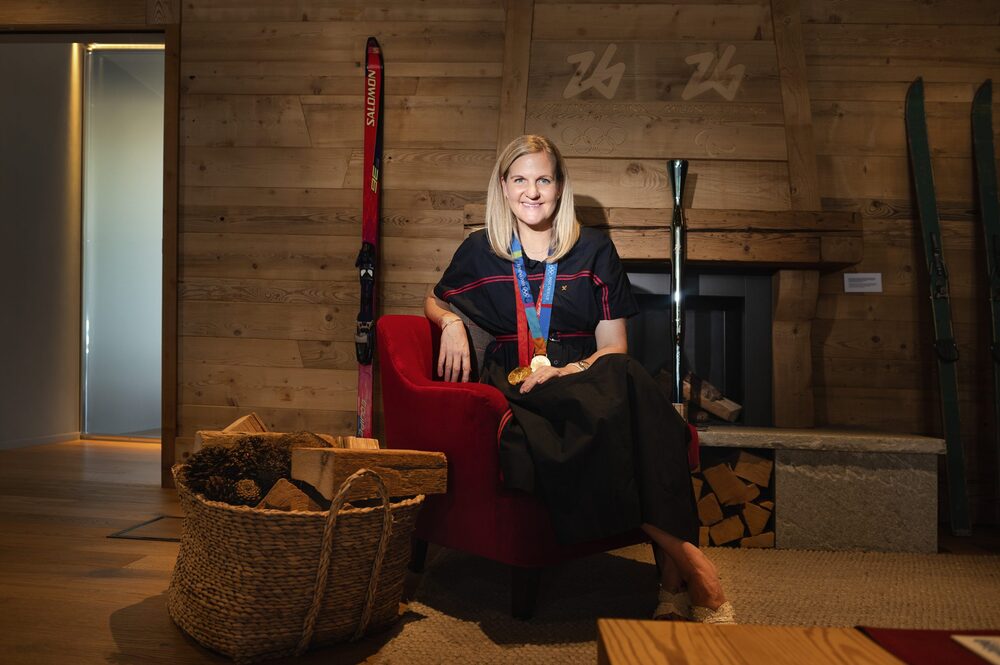
Kirsty Coventry, President of the International Olympic Committee and two-time Olympic swimming champion (Photo by Gerald Bruneau © Fondazione Bracco)
Breaking Stereotypes Through Collective Commitment
“This gallery is a narrative of stories steeped in strong values,” explained Diana Bracco, “featuring courageous women who have made their mark in disciplines once considered exclusively male. Our commitment is to make their expertise visible.” Councillor Alessia Rotta echoed the point, recalling that investing in women’s sport means investing in the future: “talent has no gender and deserves equal opportunities — from professional recognition to social protections.”
The initiative is part of the broader #100esperte project, an online database created to counter the marginalisation of women in the media (where men are quoted as experts 70% of the time). Sport, which joined the database in 2023, is the latest frontier in this battle for merit.
The Games are a unique opportunity to speak to millions of people, stressed Andrea Monti, Head of Communications at Milano Cortina 2026 — not just an event, but a platform for lasting change. The scientific research, which will for the first time offer a comprehensive picture of how sport is covered in Italy, aims to monitor media coverage and narrative through to March 2026. The goal is not just to take a snapshot of the present, but to leave behind a legacy of knowledge and a kind of “toolbox” of best practices for those who come after.
Sport as Freedom and Rebirth
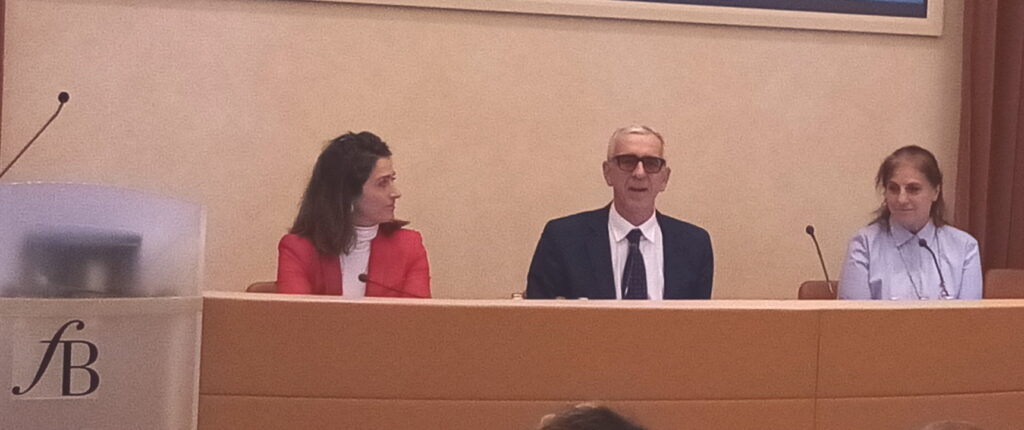
Giving flesh and soul to the debate — moderated by SportWeek editor Pier Bergonzi — were two icons of Italian sport: Gerda Weissensteiner and Martina Caironi, both Olympic flag bearers for Italy, at Nagano 1998 and Rio de Janeiro 2016 respectively. Their stories are living proof of how sport can dismantle age-old prejudices.
Gerda won Olympic medals in both luge and bobsled, and spoke of an equality born among the mountains. “I grew up on a farm, in a large family, and work had no gender for us,” she recalled. “The boys did the dishes, the girls brought in the firewood.” For her, sport was synonymous with freedom — a way to escape farm duties and discover her own talent. But she also experienced bureaucratic barriers first-hand: “Women weren’t allowed to compete in two-person bobsled until 2002. Today, as a coach, I still meet too many mothers who tell me they would have loved to compete — but in their time, it wasn’t allowed. We must give girls the courage to dare.”
Martina Caironi has won Paralympic medals in the 100 metres and long jump (she still holds the world record) and offered a profound reflection on the value of identity: “sport was the thread that connected my life before and after my accident. It gave me the self-esteem to find my centre again.” She also called for a change in language — pushing back against the stereotype of girls who play football being called “tomboys”: “if anything, they should have called me a femminaccia (a fiercely fierce woman) when I had both legs and played football,” she said with a smile. Girls need to be able to dream of becoming astronauts or athletes by seeing real female role models: “a Paralympic medal is not a finishing line,” she added, “but a starting point to aim even higher.”
While numerical participation is approaching parity (women were 49% of athletes in Paris and may be a majority in Los Angeles), Bergonzi reminded the audience that the real battle is now being fought on other fronts: maternity rights, pension protections, equal pay, and above all, the presence of women in decision-making roles within sports federations.
Beyond the Spotlight, You Need the Ramps
At the end of the event, we had the chance to speak with Martina Caironi to understand how deep the change really runs. Her analysis is clear-eyed: visibility has increased, but real accessibility still lags behind.
Martina, from your first Paralympics to today, how has the perception of disability in Italy changed — including around inclusion and accessibility?
“Awareness has grown because we’re more visible, more present. Laws make a difference — today they require new venues to be accessible — but there’s still a cultural barrier: people often don’t notice obstacles until they have someone in a wheelchair beside them. The Paralympics have this power: they put high-level athletes in the spotlight, forcing everyone to realise that if you want to host an event for everyone, that stage needs a ramp, that arena needs an accessible bathroom. We need to dismantle the idea that disability is synonymous with fragility or weakness.”
After such a rich competitive career, full of achievements, how do you carry what you’ve lived into everyday life?
“Sport taught me to manage stress, pain, waiting, and exhaustion. In daily life, this translates into constant problem-solving: if I have a physical issue — say, a sore knee — I don’t stop. I look for ways to use my arms or my core instead. There’s always something that can be done. High-level sport teaches you to hold on and never stand still — which is, in fact, my defining character trait.”
You’ve stayed in the world of sport in an important role, no longer just at national level — what do you hope for in your post-career?
“I try to maintain a normal life, away from the spotlight. Today I have responsibilities at the international level within the IOC, and I hope this experience can help make structural what we currently see only during major events. Sport is a school for life — but it must be a school open to everyone, without exception.”
Milan Cortina 2026, then, will be more than an event — it will be a platform for lasting change. The real victory will be measured not only on the podium, but in the capacity to break down those prejudices that, as Martina says, are often higher than any architectural barrier.reale arranca ancora.
In copertina, fotografie di Gerald Bruneau © Fondazione Bracco
La ricerca sulla copertura mediatica delle Olimpiadi e Paralimpiadi con un’ottica di genere